We have compiled a list of manufacturers, distributors, product information, reference prices, and rankings for Fluorine resin coating.
ipros is IPROS GMS IPROS One of the largest technical database sites in Japan that collects information on.

Fluorine resin coating Product List and Ranking from 37 Manufacturers, Suppliers and Companies | IPROS GMS

Last Updated: Aggregation Period:Jan 28, 2026~Feb 24, 2026
This ranking is based on the number of page views on our site.

Fluorine resin coating Manufacturer, Suppliers and Company Rankings

Last Updated: Aggregation Period:Jan 28, 2026~Feb 24, 2026
This ranking is based on the number of page views on our site.

  1. 吉田SKT Aichi//Manufacturing and processing contract
  2. フロロコート Saitama//others
  3. null/null
  4. 4 竹中製作所 Osaka//Machine elements and parts
  5. 5 null/null

Fluorine resin coating Product ranking

Last Updated: Aggregation Period:Jan 28, 2026~Feb 24, 2026
This ranking is based on the number of page views on our site.

  1. Advantages and disadvantages of re-coating a non-stick frying pan. 吉田SKT
  2. Causes of Teflon coating peeling and how to address them. 吉田SKT
  3. Fluororesin Coating: "Differences in Color and Selection Method" 吉田SKT
  4. 4 What is foldability? An explanation of materials with excellent slip properties and low friction. 吉田SKT
  5. 5 Introduction to fluoropolymer resins: ETFE, PVDF, PCTFE, ECTFE. 吉田SKT

Fluorine resin coating Product List

1~30 item / All 385 items

Displayed results

Control of contact area: Non-stick and release properties created by a unique convex surface.

Prevention of sticking for sticky materials such as molten plastic, labels, adhesive tape, and raw rubber. This series exhibits excellent non-stick and release properties!

We have prepared a series that exhibits excellent non-stick properties, particularly against adhesives, molten resins, and adhesive tapes. ■ Series Composition - Super TP/TP Series (all fluoropolymer) - Super CTT Series (surface treatment + siloxane) - Super Alloy Coating ■ Super TP/TP Series (all fluoropolymer) - Can be used in silicone-free environments. - There is no siloxane contamination due to the use of all fluoropolymers. ■ Super CTT Series (convex surface + silicone rubber-based) - Exhibits excellent non-stick properties due to the use of silicone. - Consideration is needed for transfer to the counterpart material. ■ Super Alloy Coating - A convex release coating that balances flexibility and high hardness. - Surface treatment of HV600 can also be processed onto resins and sponge rubber. *For more details, please download the PDF or feel free to contact us.

  • s-IMG_9503_edited_edited.jpg
  • アロイ ロール_edited_edited2.jpg
  • 2021-05-15 (2).png
  • Coating Agent
  • Fluorine resin coating

Added to bookmarks

Bookmarks list

Bookmark has been removed

Bookmarks list

You can't add any more bookmarks

By registering as a member, you can increase the number of bookmarks you can save and organize them with labels.

Free membership registration

Yoshida SKT Surface Treatment Function Introduction Video 'Company Introduction Video'

We will introduce Yoshida SKT in a video of about 2 minutes. Please take a look.

Yoshida SKT began fluororesin processing in 1963. In 1968, it signed a licensing agreement with DuPont in the United States. For half a century since then, we have pursued surface treatment functions, starting with Teflon™ fluororesin coatings. In response to customer needs, we have also developed numerous original coatings. At Yoshida SKT, we can accommodate a wide variety of substrates and offer proposals from hundreds of types of coating materials. This expands the range of coatings that customers can choose from. In addition to functions such as "reducing adhesion of sticky substances" and "improving slip," we respond meticulously to the diverse needs and environments of our customers, such as "requiring precision" or "requiring heat resistance," to achieve reliable effects. We also provide test pieces that can be tried on-site for support. For cost reduction in manufacturing, strengthening competitiveness, and creating a welcoming environment on-site, please feel free to consult with us first.

  • Surface treatment contract service
  • Fluorine resin coating

Added to bookmarks

Bookmarks list

Bookmark has been removed

Bookmarks list

You can't add any more bookmarks

By registering as a member, you can increase the number of bookmarks you can save and organize them with labels.

Free membership registration

Improving water repellency, oil repellency, hydrophilicity, and non-stick properties with precise surface treatment!

Achieving water repellency, oil repellency, release properties, and non-stick properties with nano-level thin films of less than 1μm. Jigs, molds, and equipment that were once given up on can be improved with nano processes.

The nano process is a coating process that forms functional materials as thin films at the nano level, below 1μm, on substrates. It enhances properties such as water repellency, oil repellency, non-stickiness, and liquid sliding. Since it causes almost no dimensional changes and can maintain optical properties, it enables processing in fields where fluororesin coatings have been difficult, such as "precision parts" and "areas requiring high dimensional and surface accuracy." <Examples of industries that require high surface accuracy> Semiconductors, Automotive, Batteries, Electronic Components, Medical Devices, etc. 【Features of Each Series】 ■ TC-10S Excellent precision of 100nm, visible light transmittance, water repellency, and oil repellency. ■ TLS Series Superior non-stickiness against adhesive materials like tape. ■ NCFPC Series Excellent liquid sliding properties for water and oil. ■ HP Series Excellent hydrophilicity. Currently, we are distributing technical materials summarizing the features and functions of all series. If you are interested in more details or are facing challenges with surface treatment in precision fields, please download the materials or contact us directly.

  • Surface treatment contract service
  • Fluorine resin coating

Added to bookmarks

Bookmarks list

Bookmark has been removed

Bookmarks list

You can't add any more bookmarks

By registering as a member, you can increase the number of bookmarks you can save and organize them with labels.

Free membership registration

Guidance for Selecting Teflon Coating

Increase profitability with optimal surface treatment! We offer a wide range of materials and processing methods to meet various needs. *There are many adoption results in other industries.

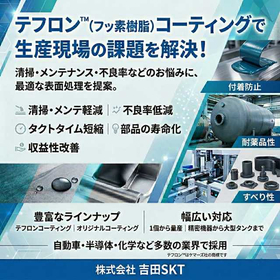
Yoshida SKT Co., Ltd. is a company that specializes in the order, design, development, manufacturing, and sales of Teflon (fluororesin) coatings and surface treatments for metals. We accept consultations regarding issues such as "reduction of cleaning and maintenance work," "decrease in defect rates," "shortening of takt time," and "extending the lifespan of parts," as well as improvements in profitability. We can provide proposals based on a wide range of materials and treatment methods that are optimally customized for characteristics such as "non-stick," "slipperiness," and "chemical resistance." Our services are adopted in numerous fields, including automotive, semiconductors and LCDs, communication equipment, and chemical plants. 【Features】 ■ Teflon coating ■ Original coatings tailored to needs ■ Flexible support from single units to mass production ■ Capable of construction from fine precision equipment to large tanks ■ Proposals based on a wide range of materials and treatment methods *For more details, please refer to our catalog or feel free to contact us.

  • Surface treatment contract service
  • Fluorine resin coating

Added to bookmarks

Bookmarks list

Bookmark has been removed

Bookmarks list

You can't add any more bookmarks

By registering as a member, you can increase the number of bookmarks you can save and organize them with labels.

Free membership registration

[Case Study in the Electronic Components Industry] Adhesion Prevention for Plating Jigs - Non-Stick Coating

Case study of surface treatment solutions in the electroplating process of electronic components! Introducing a successful case of cost reduction through improved adhesion of plating and better drainage of plating solution.

Here is an example of preventing plating adhesion to jigs used in the plating process. ■Concern In the process of applying electroplating to electronic components, plating was adhering to the jigs used to secure the products, resulting in time and costs for the peeling process. Additionally, when plating adhered, the jigs tended to deteriorate more easily, leading to an increased frequency of replacements. ■Coating Effect By providing insulation through our "fluororesin coating," the amount of plating adhesion to the jigs was significantly reduced. It also demonstrated excellent corrosion resistance, providing protection from plating solutions containing acids and alkalis. Furthermore, the lifespan of the jigs improved, and the amount of plating solution taken out was reduced. Our customers were pleased with the successful cost reduction. 【Key Points】 ■Purpose of Surface Treatment: Quality and operational stability, reduction of replacement and material costs, compliance with safety and environmental requirements ■Required Functions: Non-stick and release properties, rust and corrosion resistance, electrical properties ■Adopted Treatment: Fluororesin Coating (Teflon Coating) *For more details, please refer to the PDF document or feel free to contact us.

  • Processing Contract
  • Fluorine resin coating

Added to bookmarks

Bookmarks list

Bookmark has been removed

Bookmarks list

You can't add any more bookmarks

By registering as a member, you can increase the number of bookmarks you can save and organize them with labels.

Free membership registration

Fluororesin coating, suitable for room temperature processing, 'Cerashield F'

Can be processed at room temperature without the need for heat treatment such as entering a firing furnace! Protects against acids and alkalis.

"Serashield F" is a coating made from a fluorine-based material that can be applied at room temperature and has excellent chemical resistance. By protecting equipment and jigs from acids, alkalis, and dirt, it extends the replacement period, improves cleaning and maintenance, and leads to cost reduction. It can be applied to various materials, including metals, PVC, PET, and polycarbonate, making it suitable for a wide range of substrates. 【Features】 ■ Can be applied to various substrate materials ■ Coating is possible not only for various metals but also for resins such as PVC, PET, and polycarbonate ■ Fluorine-based material that can be processed at room temperature ■ No need for heat treatment such as placing in a furnace *For more details, please refer to the PDF document or feel free to contact us.

  • IMG_1855_edited.jpg
  • Surface treatment contract service
  • Fluorine resin coating

Added to bookmarks

Bookmarks list

Bookmark has been removed

Bookmarks list

You can't add any more bookmarks

By registering as a member, you can increase the number of bookmarks you can save and organize them with labels.

Free membership registration

Fluororesin Coating: "What is the Non-Stick Property of Fluororesin?"

What are the characteristics of the representative property of fluoropolymer coatings, specifically Teflon coatings, known as "non-stick"? Here, we will introduce the non-stick functionality.

■ The "Non-Stick Property" of Fluoropolymer Non-stick property refers to the characteristic of being easy to release and not adhere, or to adhere less, even to strongly adhesive substances. For example, fluoropolymers excel in water and oil repellency, have a large contact angle, and possess a property of being difficult to wet due to their molecular structure. The measure of wettability, "critical surface tension (γc)," is extremely low for fluoropolymers, making it easy for liquids to be repelled and difficult to wet. Coatings that utilize this functionality are effective for release applications, applications where adhesion needs to be minimized, and for simplifying cleaning. 【Reference Data on Non-Stick Property】 ■ Contact Angle of Water (°) PTFE ... 114 PFA ... 105-110 FEP ... 115 ETFE ... 96 ■ Contact Angle of n-HD (°) PTFE ... 34-45 PFA ... >45 FEP ... 41-45 ETFE ... 28 ■ Surface Free Energy of Solids (dyn/cm) PTFE ... 18.5 PFA ... 17.8 FEP ... 17.8 ETFE ... 22.1 *For detailed information on non-stick properties, please download the PDF or contact us.

  • Resin mold
  • Fluorine resin coating

Added to bookmarks

Bookmarks list

Bookmark has been removed

Bookmarks list

You can't add any more bookmarks

By registering as a member, you can increase the number of bookmarks you can save and organize them with labels.

Free membership registration

Fluororesin Coating: "Industries and Applications"

We have over half a century of processing experience with fluororesin coatings that excel in non-stick, water-repellent, and slip properties, as well as high heat resistance and chemical resistance.

■ Industries and Applications of Fluororesin Coating - Semiconductor Manufacturing Equipment Plating jigs / Semiconductor production lines / Vacuum chambers, etc. - Automotive Industry CFRP molding processes / Conveying equipment / Molding dies / Cutter blades, etc. - Food Equipment Automatic cooking lines / Baking molds, etc. - Industrial Fields Injection molding dies / Resin molding dies / Vacuum forming dies / Rolls, etc. - Chemical Plants Tanks / Piping / Mixers / Centrifuges, etc. - General Equipment Precision machine parts / Escalator guides / Vacuum pumps, etc. - Office Automation Equipment Fusing rolls / Separation claws, etc. - Aerospace Industry Equipment Aircraft parts, rocket parts and jigs, CFRP molding dies, etc. Yoshida SKT has been processing fluororesins since 1963 (Showa 38) and entered into a licensing agreement with DuPont's headquarters in the United States in 1968, providing Teflon fluororesin processing for various industries. *For more detailed information about fluororesin coating, please download our catalog or feel free to contact us directly.

  • tefron.png
  • 2021-06-02 (10).png
  • 2021-05-01 (2).png
  • s-0078ZLedit.gif
  • s-00718Nedit.gif
  • Surface treatment contract service
  • Fluorine resin coating

Added to bookmarks

Bookmarks list

Bookmark has been removed

Bookmarks list

You can't add any more bookmarks

By registering as a member, you can increase the number of bookmarks you can save and organize them with labels.

Free membership registration

[Surface Treatment Case] Improvement of Sliding in Robot Conveyance - Coating with Excellent Slipperiness

We solve transportation challenges with coatings that excel in lubricity and wear resistance to prevent robots from stalling.

- Smooth operation of the line is necessary for the automation of transport lines using robots. ■ Sites requiring surface treatment - Factories aiming for increased manufacturing efficiency and speed. - Sites where the transport line is being accelerated to match the high-speed movement of robots, raising concerns about jams and difficulties in flow. ■ Points of innovation - By applying surface treatments that improve slipperiness to guides and chutes on the transport line, we can prevent troubles such as jams and difficulties in flow. - For example, in lines where unstable shapes are supported by guides or in transport processes for products with grip, changing the slipperiness of contact surfaces through coating can smoothen transport and reduce the likelihood of sudden line stoppages. ■ Coatings to improve robot transport troubles - Bi-Coat® "Slipperiness + Wear resistance" - Convex coating for reduced contact area "Slipperiness + Reduced contact area" - Teflon™ fluororesin coating "Slipperiness + Prevention of product scratches" *For more details, please download the PDF or feel free to contact us.

  • 調整00000012_edited.jpg
  • 調整00000013_edited.jpg
  • 調整00000014_edited.jpg
  • 調整00000015_edited.jpg
  • 調整00000016_edited.jpg
  • Surface treatment contract service
  • Fluorine resin coating

Added to bookmarks

Bookmarks list

Bookmark has been removed

Bookmarks list

You can't add any more bookmarks

By registering as a member, you can increase the number of bookmarks you can save and organize them with labels.

Free membership registration

[Automotive Industry Case] Soft rubber that doesn't adhere! Non-stick coating

Solve demolding troubles with silicone-free fluorine coating! Introducing a coating that prevents sticking for tire transport types.

We will introduce a case of surface treatment that improved rubber sticking troubles in tire manufacturing equipment. ■Problem During the transportation process of tire manufacturing, when removing the donut-shaped rubber from the transport mold, the rubber stuck and could not be removed smoothly. This frequently caused line stoppage troubles, resulting in decreased production efficiency. As a solution, we tried a standard Teflon coating, but because the coating surface was smooth and slippery, the still-soft rubber stuck like a suction cup, proving ineffective. ■Request Silicone coatings and silicone release agents, which excel in release force, cannot be used due to the issue of silicone transfer interfering with the subsequent rubber bonding process. Therefore, a silicone-free release coating was required. ■Challenges to be solved - Release troubles - Line stoppage troubles - Decreased productivity ■Coating that resolved the issues Super TP Hemisphere Graphic HS How the issues were resolved can be found in detail by downloading the PDF or by contacting us.

  • s-IMG_9909_edited.jpg
  • Surface treatment contract service
  • Fluorine resin coating

Added to bookmarks

Bookmarks list

Bookmark has been removed

Bookmarks list

You can't add any more bookmarks

By registering as a member, you can increase the number of bookmarks you can save and organize them with labels.

Free membership registration

[Automotive Industry Case] Cutting Blade Raw Rubber Adhesion Prevention - Fluorine Non-Stick Coating

Raw rubber does not stick. A silicone-free, fluorine non-stick coating prevents raw rubber from adhering to blades! We will introduce case studies of solutions through surface treatment.

We would like to introduce a case of surface treatment that improved the adhesion issues of cutting tools used for cutting raw rubber. ■Concern Typically, when cutting tools come into contact with the material, their sharpness deteriorates. In the process of cutting soft and sticky raw rubber, if the sharpness of the tool decreases, defects such as burrs on the product occur. Reducing defects requires cleaning the tools, which is labor-intensive. ■Request For materials like raw rubber that are soft and highly adhesive, standard Teflon coatings are smooth and slippery, causing them to stick like a suction cup. Additionally, since cutting raw rubber is performed at temperatures around 200°C, a coating that can withstand that environment was necessary. 【Issues to be resolved】 - Product defects due to burrs - Adhesion of raw rubber - Heat resistance - Cleaning costs and labor expenses ■Adopted Coating 'TP Coating TP-411' *For detailed solutions, please download the PDF or contact us.

  • Surface treatment contract service
  • Fluorine resin coating

Added to bookmarks

Bookmarks list

Bookmark has been removed

Bookmarks list

You can't add any more bookmarks

By registering as a member, you can increase the number of bookmarks you can save and organize them with labels.

Free membership registration

[Surface Treatment Case] Reduced line downtime by preventing sticking of rubber products!

Reduced maintenance work with an anti-adhesion coating inside the vacuum nozzle. Prevents nozzle clogging and improves productivity!

■Concern In the process of removing burrs generated when molding rubber products by sucking them in with a vacuum nozzle, there is a stickiness due to the freshly molded products, which causes them to adhere to the inner diameter of the nozzle. Each time the nozzle gets clogged, it is necessary to stop the line and clean it, which decreases work efficiency and productivity. ■Background of the Request Initially, we tested fluororesin coating, but during the testing phase, we observed some adhesion on the surface. After repeating the tests several times, we found that the adhesion worsened progressively. 【Issues to be Resolved】 - Reduction of cleaning time - Improvement of productivity - Cost reduction ■Adopted Coating 'MRS-102' ■Effects of Adoption We proposed the 'MRS coating,' which has effects comparable to the release agents used in rubber molding. In tests, there was no adhesion, and we began prototype testing with actual nozzles. By coating the inner diameter, adhesion of burrs to the inner surface of the nozzle was eliminated, resulting in no downtime for removal work and successfully improving production efficiency. *For more details on the coating, please download the PDF or contact us.

  • Surface treatment contract service
  • Fluorine resin coating

Added to bookmarks

Bookmarks list

Bookmark has been removed

Bookmarks list

You can't add any more bookmarks

By registering as a member, you can increase the number of bookmarks you can save and organize them with labels.

Free membership registration

[Presentation of Materials] Surface Treatment Selected in the Automotive Parts Field "By Application"

We will introduce functional surface treatments with excellent properties such as release, insulation, and slip, which are adopted in new energy development fields such as electric vehicles and fuel cell vehicles.

■ Applications such as painting jigs, rubber product transport jigs, and label application processes 【Preferred Surface Treatments】 'Teflon(TM) Coating' 'Fluororesin Coating' ■ Applications such as resin and comb molds 【Preferred Surface Treatments】 'Bicoat(R)' 'Nanoprocess(R)' ■ Applications such as transport chutes, hoppers, and positioning jigs 【Preferred Surface Treatments】 'Polyurethane Coating' ■ Applications such as belt welding jigs and nozzles 【Preferred Surface Treatments】 'Nanoprocess(R)' ■ Applications such as transport jigs, chuck claws, and transfer jigs 【Preferred Surface Treatments】 'Bicoat(R)' ■ Applications such as hot melt release, raw rubber release, and alignment jigs 【Preferred Surface Treatments】 'MRS Coating' (Silicone Coating) ■ Applications such as label placement tables and discharge trays ・Preferred Surface Treatments 'Super TP Coating' *The above surface treatment products can be downloaded in PDF format. For detailed information about the products, please visit the "Yoshida SKT Official Website."

  • Surface treatment contract service
  • Fluorine resin coating

Added to bookmarks

Bookmarks list

Bookmark has been removed

Bookmarks list

You can't add any more bookmarks

By registering as a member, you can increase the number of bookmarks you can save and organize them with labels.

Free membership registration

Introduction to fluoropolymer resins: ETFE, PVDF, PCTFE, ECTFE.

What are the various types of fluororesins? We will introduce the characteristics of ETFE, PCTFE, ECTFE, PVdF, and PVF resins.

■ETFE (Ethylene Tetra Fluoro Ethylene copolymer) A copolymer of TFE and ethylene, it is a resin with excellent processability. Since it is not a perfluoropolymer, its chemical resistance is slightly lower. Melting point: 220-270℃ ■PVdF (Poly Vinylidene Fluoride) A homopolymer of vinylidene fluoride (VdF), it is hard and has the highest dielectric constant among fluoropolymers, dissolving in polar solvents at high temperatures. Melting point: 170-175℃ ■ECTFE (Ethylene Chloro Tri Fluoro Ethylene copolymer) A copolymer of chlorotrifluoroethylene (CTFE) and ethylene, it has excellent processability and superior flame resistance and hardness compared to ETFE. Melting point: 230-250℃ ■PCTFE (Poly Chloro Tri Fluoro Ethylene) A homopolymer of chlorotrifluoroethylene (CTFE), it is transparent and hard, with the lowest gas permeability among fluoropolymers. Melting point: 210-215℃ For more details, please download the PDF document or contact us.

  • Surface treatment contract service
  • Fluorine resin coating

Added to bookmarks

Bookmarks list

Bookmark has been removed

Bookmarks list

You can't add any more bookmarks

By registering as a member, you can increase the number of bookmarks you can save and organize them with labels.

Free membership registration

ステンレスガイドの滑り・耐摩耗を実現!自動包装機への表面処理採用

フッ素樹脂コーティングの摩耗対策に!今まで諦めていた滑り性と耐摩耗性を両立させた表面処理採用事例をご紹介します。

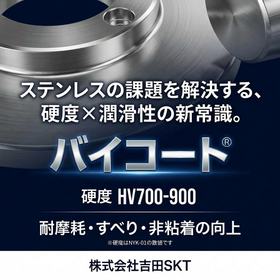
■お悩み 食品の包装時の搬送工程で、ステンレスガイドが製品搬送の抵抗になり、 ラインが詰まってしまう現象が発生していました。 それによって装置が停止し、製品がストップしまうことがお悩みでした。 ■背景 搬送ガイドには、通常はステンレスの磨き材を使用しますが、 搬送製品が高速で大量に搬送されるため、少しでも滑りにくい状態になると、 製品が詰まって装置が停止してしまいます。 包装機の製品の滑り性向上に実績のある「フッ素樹脂コーティング」を検討 しましたが、製品が高速で流れるためコーティングの摩耗紛による異物混入 の懸念があり採用にはいたりませんでした。 ■採用されたコーティング バイコート(R) ■実現できた効果 バイコート(R)は無機系材料と有機系材料を複合化した高耐久フッ素系有機コ ーティングです。HV700-900の硬い被膜と、フッ素樹脂が持つ潤滑性の特性 で、耐摩耗性と滑り性を両立。製品のスムーズな搬送とコーティングの摩耗 問題を解決できました。 ※『バイコート(R)』の製品情報をPDFでダウンロード頂けます。

  • Other surface treatment equipment
  • Fluorine resin coating

Added to bookmarks

Bookmarks list

Bookmark has been removed

Bookmarks list

You can't add any more bookmarks

By registering as a member, you can increase the number of bookmarks you can save and organize them with labels.

Free membership registration

[Packaging Machine Case Study] Wear-Resistant and Non-Stick Coating for Heat Sealers

A heat sealer that requires compatibility with packaging materials! Troubles are resolved with Bi-Coat, which combines non-stick properties and durability.

We will introduce examples of surface treatment in pillow packaging machines used for packaging food and pharmaceuticals. ■ Adhesion Issues with Heat Sealers The films used for pillow packaging vary in thickness and functionality depending on their application. In thicker packaging films that excel in preserving product quality, a resin that melts easily is used on the inner surface. When heat sealing, the resin on the sealing surface adheres to the heating part of the sealer, leading to issues such as product contamination. ■ Coating Used Bicoat "NYF-11-S" ■ Background and Effects of Adoption While plating treatment is often used to prevent adhesion on heat sealers, the soft, melted resin tends to stick to the heat sealer and does not come off. Fluororesin coatings were considered, but under high temperature and pressure conditions, there was a high risk of the coating peeling off, making it unsuitable for use. Yoshida SKT's Bicoat eliminates resin adhesion to the sealer due to its excellent release properties, and the high hardness coating with superior adhesion improves durability. This has led to a reduction in product defects and successful packaging using new materials. You can request a sample book of coatings suitable for sealers through the link provided.

  • 2021-06-10 (2).png
  • s-0186XT.jpg
  • Surface treatment contract service
  • Fluorine resin coating

Added to bookmarks

Bookmarks list

Bookmark has been removed

Bookmarks list

You can't add any more bookmarks

By registering as a member, you can increase the number of bookmarks you can save and organize them with labels.

Free membership registration

[Pharmaceutical Industry Surface Treatment Case] Achieving Automation of Transport Equipment in Sterile Rooms

Solve the "clogging" of the eye drop resin bottle production line! Achieve reduced maintenance of transport equipment and automation of the clean room with fluorine coating!

This is a case of surface treatment for equipment that transports eye drop bottles arranged in a line, which are dispensed from a prescription. ■Problems to Solve Eye drop bottles were being transported in a manner where they were pushed out one after another over the transport chute. However, on the flat metal surface of the chute, the bottles tended to stick and were difficult to slide, leading to blockages and tipping during transport. ■Goals to Achieve Due to the need for minimal human traffic in the sterile room, it was necessary to use the equipment for at least six months without maintenance, and a surface treatment that improves sliding was requested. ■Background for Coating Selection While fluororesin coatings, which have excellent sliding properties, initially performed well, the surface would become polished due to friction with the bottles. Once worn down to a flat and smooth state, the sliding ability decreased, leading to issues. Additionally, a method was considered where the substrate would be pre-treated to form a rough surface before coating, thereby reducing the contact area. However, since different metals such as aluminum and stainless steel were used for the chute substrate, variations in hardness led to significant changes in surface roughness, and difficulties in processing arose depending on the material. ■Adopted Coating 'TP Coating' ▼ Click here for details on the coating!

  • 調整00000014_edited.jpg
  • 調整00000013_edited.jpg
  • Other conveying machines
  • Fluorine resin coating

Added to bookmarks

Bookmarks list

Bookmark has been removed

Bookmarks list

You can't add any more bookmarks

By registering as a member, you can increase the number of bookmarks you can save and organize them with labels.

Free membership registration

Fluororesin coating "Wear resistance for coatings!"

For those who want to introduce fluoropolymer coatings but are concerned about wear and peeling of the coating. Measures against peeling and wear of fluoropolymer coatings!

■Are you facing any of these issues with surface treatment? - You are using fluororesin coating to improve product slip properties, but it wears out quickly and requires reprocessing. - You want to introduce fluororesin coating for production line improvement, but you are concerned about coating wear and peeling. "We have a coating at Yoshida SKT that can address such concerns." Bicoat® is a coating that pursues a balance of [durability and strength] and [anti-adhesion and slip effect]. It reduces the possibility of troubles caused by "functional decline due to coating scratches and peeling, foreign matter contamination, and defects," which can lead to decreased production efficiency. - Provides slip properties to conveyor chutes, preventing blockages of transported items. Reduces the risk of coating peeling and foreign matter contamination. - Prevents sticking of heat sealer's bonding film and coating peeling. - Contributes to improved release properties of resin molding molds. Maintains dimensional accuracy, allows for low-temperature processing, and preserves mold quality. 'Bicoat®' samples are currently available for free. Please try the anti-adhesion and slip properties with actual materials. ▼ You can apply from the official Yoshida SKT website below.

  • damageless11.jpg
  • s-IMG_8528_edited.jpg
  • s-NYF-11-S (2).jpg
  • s-NYK-01 (4).jpg
  • Other Auto Parts
  • Fluorine resin coating

Added to bookmarks

Bookmarks list

Bookmark has been removed

Bookmarks list

You can't add any more bookmarks

By registering as a member, you can increase the number of bookmarks you can save and organize them with labels.

Free membership registration

Sustained release properties surpassing fluororesin! The release effect of resin-welded plates has improved threefold.

The welding process for containers and lids necessary in the production line of lead-acid batteries. We will introduce examples of coatings that suppress resin adhesion to the welding mold and allow for long-term use!

■Concerns Lead-acid batteries, widely used in automobiles and commercial power sources. In the production process, after filling a resin box with electrodes and other components, the container and lid are welded to seal them. The heating plates used for welding are made of aluminum and are heated to over 200°C, but due to the occurrence of melted resin and stringing, a fluororesin (PTFE) coating was applied. ■Background In a production line that operates at temperatures above 200°C and produces several thousand shots a day, the coating on the heating plates peels off in less than a week. Reprocessing the coating has caused issues such as the hassle of changing setups and damage to molds, leading to decreased production efficiency. ■Adopted Coating "CHC-1111CR" ■Adoption Background and Effects Therefore, we proposed the newly developed "CHC-1111CR," which has equivalent release properties to fluororesin coatings and high hardness of the coating film during heating, making it resistant to peeling and wear. Testing on the actual line showed no stringing of the resin and no peeling of the coating, allowing for use in tens of thousands of shots and achieving a lifespan approximately three times that of conventional coatings. *For more details, please refer to the PDF document.*

  • FireShot Capture 492 - 【新開発】表面処理CHC(セラミックハードコート)のご紹介 - コーティングマガジン - 吉田SKT - www.y-skt.co.jp.png
  • Resin mold
  • Fluorine resin coating

Added to bookmarks

Bookmarks list

Bookmark has been removed

Bookmarks list

You can't add any more bookmarks

By registering as a member, you can increase the number of bookmarks you can save and organize them with labels.

Free membership registration

Fluororesin Coating: "What is 'Blasting' in Surface Preparation?"

Surface treatment for firmly adhering a non-stick "fluoropolymer coating" to the substrate. This explains "blasting."

■What is blasting? Blasting is a surface treatment method that involves spraying blast materials (various abrasive particles) onto the surface of a product using compressed air or similar means to remove rust and dirt from the substrate surface. The particles that collide with the surface act as "impact" or "cutting." Although the energy of a single blast particle is minimal, the continuous bombardment of countless particles results in a significant effect on the surface. ■Blasting as a pre-treatment In addition to cleaning the surface, blasting increases the surface area through roughening, which generates an anchor effect that greatly enhances adhesion during coating processes. Therefore, it is extremely effective not only for fluoropolymer coatings but also as a pre-treatment for processes such as thermal spraying and plating. Additionally, blasting can improve the wettability of liquids. To fully realize the performance of fluoropolymer coatings, pre-treatment is a crucial process. At Yoshida SKT, we select blast materials and treatment methods suitable for coatings and substrates to process fluoropolymer coatings. *For more details, please check the link below or feel free to contact us.

  • Surface treatment contract service
  • Fluorine resin coating

Added to bookmarks

Bookmarks list

Bookmark has been removed

Bookmarks list

You can't add any more bookmarks

By registering as a member, you can increase the number of bookmarks you can save and organize them with labels.

Free membership registration

Fluororesin Coating: "What is the 'Air Baking' in the Degreasing Process?"

A degreasing process to ensure strong adhesion of the non-stick "fluororesin coating" to the substrate. This explains "pre-baking."

■ What is the degreasing process? It is the process of removing oils, fats, and dirt that are attached to the surface to be coated. ■ Issues arising from insufficient degreasing It can lead to problems such as the coating material repelling, poor adhesion of the paint film, and the occurrence of appearance defects like stains. ■ Types of degreasing methods - Air roasting - Solvent cleaning ■ Air roasting process The substrate is heated in a roasting furnace to a temperature above the coating processing temperature, allowing oils and other substances to be oxidized and burned off. Typically, roasting is performed for several hours at temperatures exceeding 400°C. ■ Advantages of air roasting - No toxic gases are generated during the decomposition of oils, which are broken down into water and carbon dioxide. - It can completely decompose all organic components that could cause problems during the coating firing process. - It can accommodate large products as long as they fit into the roasting furnace. Fluoropolymer coatings, which excel in non-stick properties, adhere firmly to the substrate and perform effectively when a proper degreasing process (surface preparation) is carried out. * For an overview of the fluoropolymer coating process, please download the PDF or feel free to consult us.

  • Surface treatment contract service
  • Fluorine resin coating

Added to bookmarks

Bookmarks list

Bookmark has been removed

Bookmarks list

You can't add any more bookmarks

By registering as a member, you can increase the number of bookmarks you can save and organize them with labels.

Free membership registration

Fluororesin Coating: "What is the Lubricity of PTFE?"

[Presentation of Information] What makes fluoropolymer excellent in lubrication? We will introduce the characteristics of fluoropolymer PTFE, focusing on its lubrication and low friction properties.

■Types of Lubrication Lubrication can be broadly divided into liquid lubrication using liquids and solid lubrication using solids. A representative example of liquid lubrication is lubrication with oil. On the other hand, lubrication with fluororesin falls under the category of solid lubrication. ■Characteristics of Solid Lubrication Solid lubrication is used in cases where liquids cannot be used or when liquids evaporate or detach in a vacuum. For example, when sliding products, solid lubrication is useful in cases where liquid lubricants would dirty the products. ■Lubricity and Low Friction of Fluororesin (PTFE) Fluororesin has a low coefficient of friction and is used as a solid lubricant. Fluororesin PTFE is structured such that fluorine atoms surround carbon atoms without gaps. The free energy of the fluorine atoms on the molecular surface is low, and the molecules have a very small polarity due to their symmetrical structure. The low coefficient of friction of PTFE is believed to be influenced by this type of molecular structure. ■Reasons for the Low Coefficient of Friction of Fluororesin PTFE → For more details, please check the basic information section.

  • Other Auto Parts
  • Fluorine resin coating

Added to bookmarks

Bookmarks list

Bookmark has been removed

Bookmarks list

You can't add any more bookmarks

By registering as a member, you can increase the number of bookmarks you can save and organize them with labels.

Free membership registration

Fluororesin Coating: "Differences in Color and Selection Method"

We will introduce the differences in color and how to choose coatings that encapsulate fluororesin, such as fluorine processing and fluororesin coatings.

■What color is fluoropolymer? The fluoropolymer coating commonly seen on household frying pans is often a dark color, but PTFE, which is frequently used for frying pan coatings, appears milky white under sunlight. ■Colors of fluoropolymer coatings Fluoropolymer coatings come in various colors, including green and gray, in addition to dark colors. This is because the coating materials are colored to enhance aesthetics and allow for differentiation based on purpose. ■Differences by color The differences in color of fluoropolymer coatings are not closely related to the type or characteristics of the resin. For example, green does not necessarily indicate PFA, nor does black indicate PTFE. Since fluoropolymer coatings are functional films, it is essential to choose them appropriately based on their intended use and environment. In such cases, it is important to consult a reliable processing company rather than selecting based solely on color. ■Fluoropolymer coatings for specific applications Fluoropolymer coatings demonstrate various functions depending on the type of resin, film thickness, and processing methods, across different applications and environments. It is crucial to select the appropriate coating based on the intended use, such as for non-stick purposes or corrosion resistance.

  • ネジ フッ素樹脂コーティング_edited.jpg
  • Surface treatment contract service
  • Fluorine resin coating

Added to bookmarks

Bookmarks list

Bookmark has been removed

Bookmarks list

You can't add any more bookmarks

By registering as a member, you can increase the number of bookmarks you can save and organize them with labels.

Free membership registration

Presenting case studies of "Bycoat" solutions [Collection of improvement case studies in equipment processes]!

[8 case studies included] For those seeking both "strength" and "anti-adhesion" in molding and packaging processes! We are offering a collection of case studies summarizing specific examples and their effects.

Yoshida SKT's surface treatment "Bicoat" is a technology that achieves both "durability" and "non-stick/slippery properties" on the coated surface. Generally, the challenges in the molding and packaging processes involve complex factors, and there are many cases where the desired functions are not met with current coatings. Examples: - High durability but insufficient slipperiness... - Anti-adhesion is achieved, but the coating peels off quickly... - Insufficient dimensional stability for molding dies... Our original surface treatment "Bicoat" can solve these challenges. We have received the following feedback from companies that have implemented it: - Drastically reduced application amount of release agents - Reduced defects in molded products - Extended lifespan of molds - Improved accuracy and quality in the packaging process Currently, we are offering a collection of improvement case studies featuring eight examples of how Bicoat has resolved issues in molding and packaging processes! [Features] - Amazing durability - High hardness, resistant to scratches - Excellent wear resistance - Outstanding non-stick and release properties - Reliable for molds requiring micron-level dimensional accuracy *For more details, please download the materials or contact us through our website.

  • 2021-05-16 (2).png
  • edit_edited.jpg
  • IMG_8557_edited_edited.jpg
  • NYK-01 (4)_edited.jpg
  • s-シーラー.jpg
  • NYF-11-S 1_edited.jpg
  • s-0181UC_edited.jpg
  • Other molds
  • Fluorine resin coating

Added to bookmarks

Bookmarks list

Bookmark has been removed

Bookmarks list

You can't add any more bookmarks

By registering as a member, you can increase the number of bookmarks you can save and organize them with labels.

Free membership registration

[Surface Treatment Solution Case] Achieving both high-temperature release and long lifespan with thermal welding type!

Improvement of the thermal fusion process of the filter case through surface treatment. Achieving reduced thread pulling and long lifespan with heat-resistant fluorine coating!

■Consultation In the production process of cartridge filters, the adhesion of resin to the heat welding plate used for welding the products has been a problem. The products are completed by thermally welding polypropylene containers and lids, but PP resin tends to cause stringing and adhesion to the welding jigs, negatively affecting the product's airtightness, appearance, and production efficiency. Therefore, the heat welding plates required not only excellent release properties but also heat resistance and thermal durability. ■Background of Coating Selection In the prototype, in addition to the standard fluororesin coating, we proposed a contact area-reducing fluorine coating "TP-855." Since the welding process involved relatively low pressure, the release properties improved, making stringing and adhesion less likely. Additionally, it was used for a relatively long lifespan. ■History and Effects of Coating To further extend the lifespan of the release effect, we considered hybridizing the high thermal hardness CHC series with the contact area-reducing coating. Aiming for even longer lifespan, we proposed "CHC-1311," which balances thermal hardness and contact area reduction. Currently, there is no metal exposure due to wear, and it is being used effectively. If you are facing issues in the heat welding process, please consult Yoshida SKT.

  • Resin mold
  • Fluorine resin coating

Added to bookmarks

Bookmarks list

Bookmark has been removed

Bookmarks list

You can't add any more bookmarks

By registering as a member, you can increase the number of bookmarks you can save and organize them with labels.

Free membership registration

Fluororesin Coating: "What is the Water and Oil Repellency of Fluororesin?"

What are the typical characteristics of Teflon fluoropolymer coating, specifically "water repellency and oil repellency"? Let me introduce the mechanism.

■What is the "Water Repellency" of Fluororesin? "Water/Oil Repellency" refers to the property of a material's surface to repel water and oil. A well-known example that illustrates this property is the lotus leaf. The lotus leaf utilizes this water repellency to keep itself clean and less prone to wetting, allowing for smooth photosynthesis. Teflon fluororesin also possesses this "water/oil repellency." For instance, even if a liquid tends to spread on a material, applying a Teflon fluororesin coating to the surface can impart water/oil repellency, causing the liquid to bead up and reducing its tendency to spread. You can find detailed information in the PDF document below. ---------------------------------------- 1. What is water/oil repellency? 2. Reasons why Teflon fluororesin excels in water/oil repellency ~Surface Free Energy~ 2-1. What is surface free energy? 2-2. The relationship between water repellency and surface free energy 3. Methods to confirm water/oil repellency ~Contact Angle~ 4. Applications of water/oil repellency ---------------------------------------- *For more details, you can download the document or view it through the link below.

  • Resin mold
  • Fluorine resin coating

Added to bookmarks

Bookmarks list

Bookmark has been removed

Bookmarks list

You can't add any more bookmarks

By registering as a member, you can increase the number of bookmarks you can save and organize them with labels.

Free membership registration

Introduction of the development product: Thin film fluororesin coating 10under.

This is a groundbreaking fluororesin coating that has made it possible to process thin films with a thickness of 10 μm, which was previously considered difficult to process.

■Development Background of Thin Film Fluororesin Coating "10under" Fluororesin coatings are sometimes requested to be processed in thin films of around 10μm when dimensional stability of the substrate is a priority. However, in the case of standard fluororesin coatings, a thickness of at least 20-50μm has been required to maintain good appearance and performance. Even so, when requests for thin film processing arise, we sometimes propose a "modified type" of fluororesin coating with a different coating structure. However, there were challenges with the modified type not being able to deliver the necessary functions. Yoshida SKT has worked on development to solve these challenges, resulting in the creation of the "Thin Film Fluororesin Coating '10under.'" ■Features of 10under - Non-stick properties equivalent to standard fluororesin coatings - Capable of processing thin films of around 10μm, reducing dimensional changes - While being a thin film, it suppresses transparency *For more details, please download the materials or contact us.*

  • 2_家比較全体.jpg
  • Surface treatment contract service
  • Fluorine resin coating

Added to bookmarks

Bookmarks list

Bookmark has been removed

Bookmarks list

You can't add any more bookmarks

By registering as a member, you can increase the number of bookmarks you can save and organize them with labels.

Free membership registration

Fluororesin Coating 'HBA-838'

Explanation of Yoshida SKT's fluororesin coating 'HBA-838'.

There are various types of resin for fluoropolymer coatings, depending on the application environment. At Yoshida SKT, we specify materials and processing based on the product number. 'HBA-838' is a type of PFA coating. By processing it to a thicker film, it results in a coating without pinholes, making it suitable for applications that require corrosion resistance. 【What is PFA (Perfluoroalkoxyalkane Polymer)?】 PFA is an improved resin of PTFE, with the same continuous use temperature of 260°C. Its melting point is around 310°C, and it has a lower thermal melt viscosity than PTFE, allowing for a continuous film with fewer pinholes that could not be achieved with PTFE during coating. As a corrosion-resistant coating, it has the best performance among fluoropolymer coatings. Additionally, PFA can exhibit superior non-stick properties compared to PTFE depending on the substrate, making it widely used for non-stick and release coatings. *For more details, please download the materials or contact us.

  • 0217VD.png
  • Secondary Cells/Batteries
  • Fluorine resin coating

Added to bookmarks

Bookmarks list

Bookmark has been removed

Bookmarks list

You can't add any more bookmarks

By registering as a member, you can increase the number of bookmarks you can save and organize them with labels.

Free membership registration

Case study of mold release for molten metal: Coating that solved polypropylene stringing.

Reduce thread pulling during thermal welding of PP with surface treatment technology! Achieve long mold life!

■Consultation In our customer's process of thermally welding polypropylene products, issues such as thread pulling and adhesion to the welding mold have arisen. The welding mold required not only release properties but also heat resistance and thermal durability. ■Background and Effects of Surface Treatment Selection Our company considered a hybrid approach of ceramic-based CHC and fluororesin-based low contact area coatings to enhance release effects and prolong the lifespan of mold exchanges. We proposed "CHC-1311," which balances thermal hardness and reduced contact area. Currently, our customers are using it to achieve both release properties and long lifespan. If you are having trouble with the release properties of welding molds, please consult Yoshida SKT.

  • Resin mold
  • Fluorine resin coating

Added to bookmarks

Bookmarks list

Bookmark has been removed

Bookmarks list

You can't add any more bookmarks

By registering as a member, you can increase the number of bookmarks you can save and organize them with labels.

Free membership registration

List of plastic materials, types, and characteristics.

We will introduce the types and characteristics of representative thermoplastic plastics.

Thermoplastic plastics are plastics that become soft when heated. Once softened, they can harden again upon cooling, which makes them excellent for processing such as molding. ■ Types and characteristics of thermoplastic plastics - Polyethylene (PE): The most widely produced plastic, used in items like shopping bags and food containers. - Polypropylene (PP): More heat-resistant than polyethylene, used in films and cases. - Polyvinyl chloride (PVC): Flame-resistant and durable, used in pipes and electrical wire coatings. - Fluororesin (PTFE): Excellent heat resistance, non-stick properties, and low friction characteristics. For more detailed information, please check the related link: "What are the differences between plastics, resins, and polymers? An explanation of the types of plastics and their advantages and disadvantages."

  • Secondary Cells/Batteries
  • Fluorine resin coating

Added to bookmarks

Bookmarks list

Bookmark has been removed

Bookmarks list

You can't add any more bookmarks

By registering as a member, you can increase the number of bookmarks you can save and organize them with labels.

Free membership registration